VINTAGE RED SPLIT PORTRAIT
Category: Portraits | Optimized For: Gemini | Aspect Ratio: 4:5
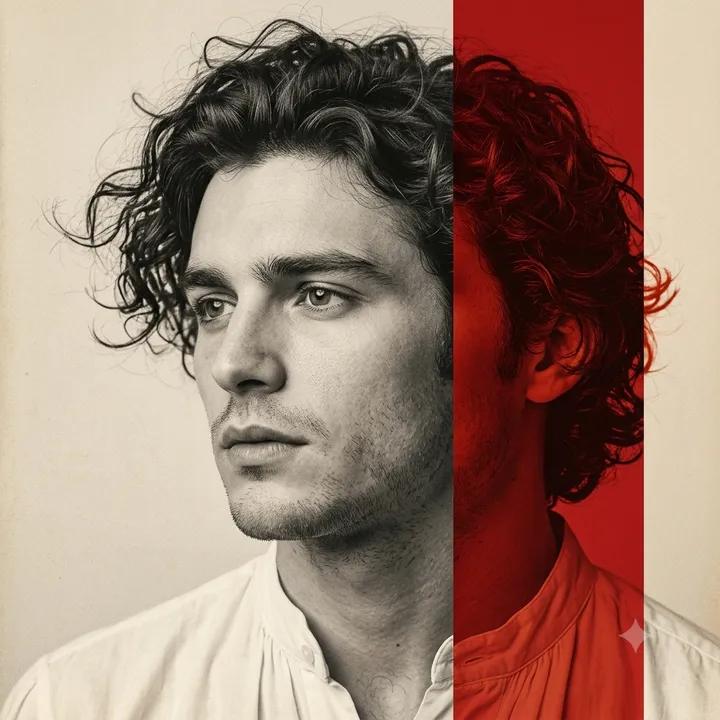
Copy-Paste AI Photo Editing Prompt
Use the uploaded image as the PRIMARY VISUAL REFERENCE. Recreate the underlying photographic artwork as closely as possible. Match the exact portrait composition, subject position, camera angle, facial expression, hairstyle, clothing, monochrome treatment, vertical red panel, proportions, background texture, lighting, and vintage editorial aesthetic. Do not redesign or reinterpret the composition. Remove all original text, typography, logos, signatures, watermarks, and poster graphics. Generate ONLY the clean artwork.

CORE CONCEPT
Create a vintage cinematic editorial portrait of a young adult man, shown from the chest upward, with his portrait divided into two radically different visual treatments.
The left ~57% of the image contains the natural monochrome/sepia portrait.
The right ~22% of the image is covered by a tall, solid deep crimson-red vertical panel, while the man's corresponding right-side portrait remains visible underneath the red treatment.
The result should look like a minimalist Korean/European film-poster portrait design, but without any text.
EXACT COMPOSITION
Use a square 1:1 composition.
The man is positioned slightly left of center.
His head occupies approximately:

20–82% of image width
4–78% of image height
His shoulders and upper chest extend toward the bottom.
The man's head is turned approximately 20–30 degrees toward the left.
He is looking toward the left side of the frame, not directly at the camera.
His expression is:
quiet, thoughtful, slightly melancholic and introspective.
Do not smile.
FACE — CRITICAL
Create a young adult male with:

Thick curly/wavy dark hair
Large natural eyebrows
Deep-set expressive eyes
Straight nose
Slightly parted lips
Defined cheekbones
Strong but youthful jaw
Very light natural facial stubble
His face should have a classic European editorial/model appearance.
Maintain realistic facial anatomy.
The visible face should be highly detailed on the monochrome side.
HAIR
The hairstyle is one of the major visual features.
Create:

Thick naturally curly/wavy hair
Medium length
Messy volume
Loose curls
Individual strands
Flyaway hairs
Large irregular silhouette around the forehead and temples
The hair should extend toward the upper-left and upper-center.
Some of the hair continues into the red section and becomes deep red/dark crimson.
Do not make the hair neatly styled.
FACE ORIENTATION
The man's face is approximately three-quarter view.
His:

Nose points toward the left
Eyes look toward the left
Chin faces slightly left
Right side of face recedes toward the red panel
Do NOT make the face frontal.
Do NOT make him look directly at the viewer.
LEFT SIDE — MONOCHROME PORTRAIT
The left side should be treated as an old photographic portrait.
Use:

Warm gray
Soft beige
Faded sepia
Charcoal
Cream
The skin should appear mostly monochrome with subtle warm beige tonal variation.
Create:

Fine film grain
Slight paper texture
Soft contrast
Vintage photographic detail
Natural skin texture
Slightly faded highlights
The overall left side should look like an archival fashion photograph printed on textured paper.
RIGHT SIDE — RED TREATMENT
Create a strong vertical crimson-red treatment covering approximately the right 20–23% of the canvas.
The red panel begins at approximately:
56–58% of the image width
and extends to approximately:
78–80% of the image width.
It runs continuously:
top edge → bottom edge.
Color:
deep cinematic crimson / scarlet red
approximately equivalent to:
#C91618 / #D0191C
Do not use bright neon red.
RED PANEL — VERY IMPORTANT
The red section is NOT a separate rectangle floating in front of the man.
It is a vertical color-overlay zone integrated with the portrait.
The man's corresponding right-side face, hair and shoulder remain visible underneath the red treatment.
Therefore:

Hair → dark red
Skin → red/orange monochrome
Ear → red
Neck → red
Clothing → red/dark crimson
The facial details remain visible through the red treatment.
VERTICAL DIVISION
There must be one perfectly straight vertical boundary between the normal monochrome portrait and the red treatment.
The boundary runs from:
top → bottom
at approximately 57% of the image width.
No diagonal division.
No torn-paper effect.
No gradient between the two sides.
The transition should be extremely clean and graphic.
RED AREA DETAILS
Within the red area, preserve:

Curly hair texture
Ear
Side of face
Neck
Shoulder
Clothing
But apply the strong red monochromatic color treatment.
The red area should have slightly darker shadows around the hair and facial contours.
CLOTHING
The man wears a minimal vintage white high-neck shirt.
The shirt has:

High collar
Slightly gathered/pleated front
Soft cotton texture
Historical/vintage styling
Loose neckline
On the left side it appears:
cream / warm white / pale beige.
Where the red panel crosses the clothing, it becomes:
deep red / crimson.
BACKGROUND
Use a very simple warm beige/cream photographic-paper background.
The background should be:

Light beige
Slightly gray
Subtly textured
Matte
Vintage paper-like
Minimal
No scenery.
No room.
No objects.
No visible studio.
The background should have extremely subtle uneven tonal variation.
LIGHTING
Use soft directional studio lighting from the upper-left/front-left.
The left side of the face should have:

Soft highlights
Gentle shadows
Detailed eyes
Natural cheek modeling
The right side becomes darker beneath the red treatment.
Avoid dramatic modern cinematic lighting.
The reference has a soft vintage photographic quality.
IMAGE TEXTURE
Recreate the physical feeling of an old printed fashion poster:

Fine paper grain
Subtle photographic grain
Slightly faded blacks
Soft beige highlights
Tiny imperfections
Mild analog texture
Low-to-medium contrast
But keep the face extremely detailed.
Do not make it look like a digital painting.
VISUAL BALANCE
The composition should be approximately:
LEFT 57%
→ beige background + monochrome portrait
RIGHT 23%
→ red portrait strip
OUTER RIGHT 20%
→ beige background with the man's red-treated silhouette subtly continuing into it.
This is important.
The red strip should not occupy the entire right half.
RIGHT EDGE
Beyond the red vertical strip, the background returns to the same warm beige/cream tone.
The man's right shoulder/upper-body silhouette can continue subtly into this area.
Keep it very soft.
PHOTOGRAPHIC STYLE
Use:
vintage European fashion editorial photography + Korean cinema poster aesthetics + analog portrait photography.
Camera characteristics:

Full-frame camera
85mm portrait lens
Natural perspective
Moderate depth of field
Fine film grain
Soft highlight roll-off
High facial detail
The final result should look like a real photograph that has been artistically color-separated, not an AI-generated illustration.
CRITICAL REFERENCE GEOMETRY
Match the reference approximately like this:

┌────────────────────────────────────────┐
│                                        │
│      CURLY HAIR                        │
│        █████████████   RED             │
│      ███████████████  █████            │
│     ████████████████  █████            │
│     MONOCHROME FACE   █████            │
│     ◉       NOSE      █████            │
│        \     LIPS     █████            │
│          \            █████            │
│           \           █████            │
│      SHIRT           █████            │
│                      █████            │
│                      █████            │
└────────────────────────────────────────┘
The red strip must be straight, vertical and dominant, while the man's face remains recognizable underneath it.
REMOVE ALL ORIGINAL TEXT
Do not reproduce any text from the reference, including:

Korean typography
English typography
Handwritten text
Release date
Logos
Credits
Watermarks
Signatures
Film title
Any poster markings
The final image must contain ZERO text.
NEGATIVE PROMPT
Do not create: frontal portrait, smiling expression, modern hairstyle, short hair, clean hairstyle, colorful background, full red image, red gradient, diagonal split, torn paper, double exposure, mirror effect, two people, duplicated face, separate red rectangle floating over the image, modern clothing, black suit, jewelry, text, Korean characters, English text, logo, watermark, typography, movie poster lettering, cartoon, illustration, anime, CGI, 3D render, excessive sharpening, plastic skin, neon red, cyberpunk, dramatic scenery.
FINAL GEMINI COMMAND
Recreate the uploaded reference as a clean, text-free vintage cinematic portrait. A young adult man with thick messy curly dark hair is shown from the chest upward in a three-quarter view, looking toward the left with a quiet introspective expression. His face, hair and upper body occupy the central-left portion of a square composition. The left approximately 57% of the portrait is rendered as a highly detailed vintage monochrome photograph with warm beige, cream, gray and subtle sepia tones, realistic skin texture, soft directional light, fine analog film grain and textured photographic-paper appearance. A perfectly straight vertical color boundary at approximately 57% image width divides the image. From that boundary to approximately 79% image width, apply a solid deep crimson-red monochromatic treatment to the exact same portrait underneath: the man's curly hair, ear, right side of face, neck and clothing remain visible but become dark red, crimson and warm red-orange while preserving all facial and hair details. Beyond the red strip, the background returns to the same warm beige/cream tone, with the man's silhouette subtly continuing into it. The man wears a simple vintage white high-neck shirt with a softly gathered/pleated front; the shirt becomes crimson wherever it falls beneath the red treatment. Maintain the exact visual hierarchy of the reference: large curly-haired male portrait, soft cream paper background, monochrome left side, narrow strong crimson vertical strip through the right side of his face, and minimal editorial composition. Use realistic 85mm portrait photography, natural perspective, subtle analog grain, soft vintage contrast, authentic skin texture and photographic detail. Do not reproduce any text or poster typography. No logos, watermark, signatures, dates, symbols or graphic lettering. Generate ONLY the clean photographic artwork.
How to Use This Prompt in Google Gemini & ChatGPT
- Copy the exact prompt formula above.
- Open Google Gemini (Nano Banana Pro) or ChatGPT Vision and upload your reference portrait if required.
- Paste the prompt and adjust subject clothing or lighting details as desired.