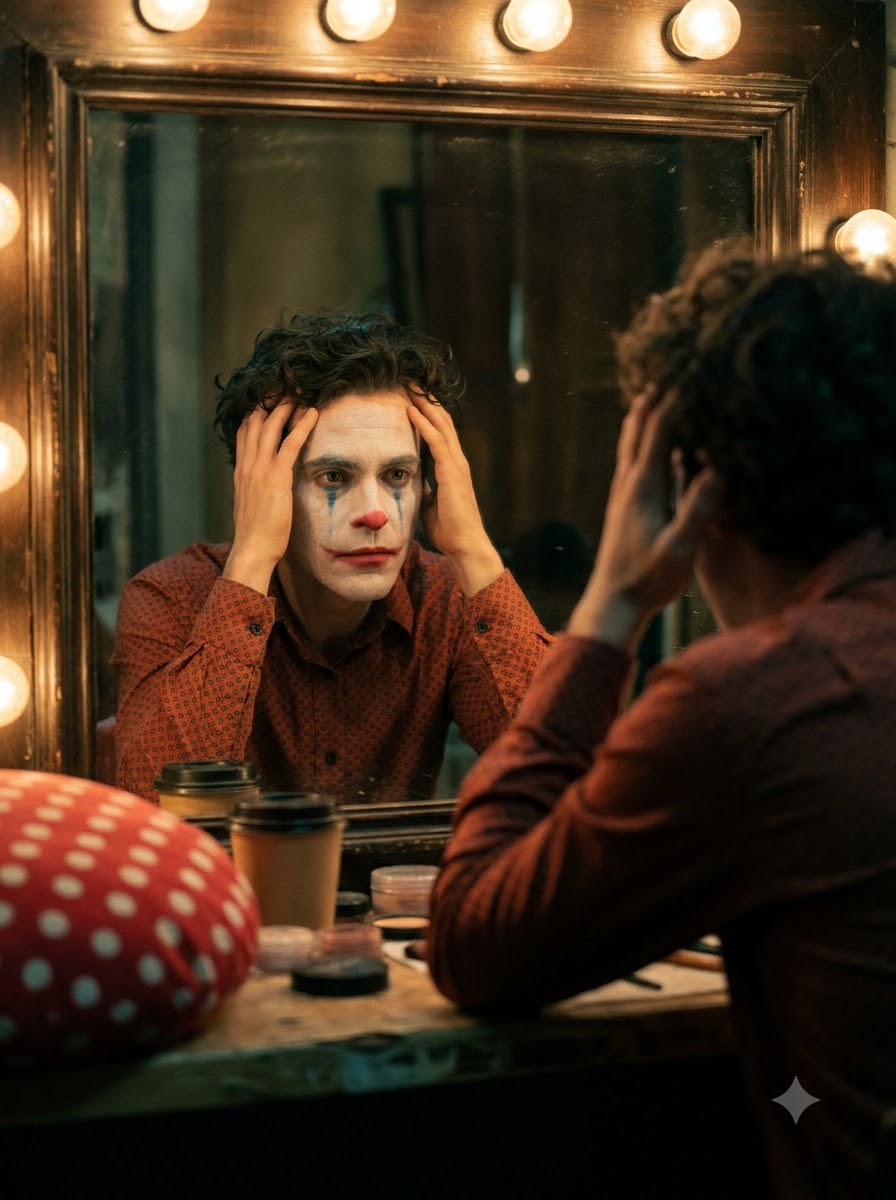
EMOTIONAL CLOWN PORTRAIT IN A VINTAGE MIRROR
Category: Portraits | Optimized For: Nano Banana Pro | Aspect Ratio: 4:5
Copy-Paste AI Photo Editing Prompt
Create a photorealistic cinematic backstage portrait of a young adult man looking at his reflection while applying or adjusting theatrical clown makeup in an old dressing room.

MIRROR COMPOSITION:
The image is photographed from behind the subject, looking directly into a tall, rectangular vintage mirror with a dark, weathered wooden frame.

The reflection fills the center. Within it, the man looks directly at himself, with a troubled, introspective expression. Both hands are raised and pressed against the sides of his head, fingers spread through his thick, messy dark-brown hair.

The actual back of his head and shoulders may appear as a softly blurred foreground shape at the lower-left, reinforcing the mirror perspective.

SUBJECT AND MAKEUP:
A young adult man with curly, disheveled dark-brown hair, pale theatrical face makeup, naturally defined eyebrows, and subtle facial texture visible beneath the makeup.

His clown makeup consists of a small round red nose, thin red lips, and two narrow blue vertical tear-like streaks extending downward from the eyes across the cheeks. The white base is matte and slightly imperfect, with believable texture near the hairline and jaw.

His eyes remain clearly visible and realistic. His expression is serious, vulnerable, and emotionally exhausted rather than comical.

CLOTHING:
A red-orange long-sleeved shirt with a small, intricate dark geometric or floral print. The fabric appears lightly textured, with realistic creases around the shoulders and elbows.

DRESSING-ROOM DETAILS:
Around the mirror, include a simple vanity surface and several small round practical bulbs near the top edge. Their warm-white and slightly amber illumination creates realistic reflections in the mirror. A few understated makeup objects sit on the vanity, softly blurred and partially visible.

The foreground-left contains a large, out-of-focus red object with large pale circular spots, resembling a theatrical clown prop or cushion. Keep it strongly blurred so that it does not obscure the mirror image.

LIGHTING:
Mixed backstage lighting combines warm tungsten bulbs with a cooler ambient fill. The face receives soft illumination from the mirror lights, revealing the white makeup texture, blue paint streaks, and natural eyes.

Use shallow depth of field: the reflected face and hands are sharply focused, while the foreground prop and outer room are softly blurred.

COLOR GRADING:
Warm amber highlights, muted red-orange fabric, cool blue makeup streaks, pale white face paint, and dark brown shadows. Cinematic contrast, realistic reflections, restrained grain, and an intimate film-still aesthetic.

CAMERA:
Vertical 9:16 portrait. Frame the mirror and the man's reflection centrally. Preserve enough of the wood frame, vanity surface, upper bulbs, and foreground prop to establish the backstage setting.

STRICT IMAGE-ONLY OUTPUT:
No text, lettering, logos, watermark, signatures, decorative borders, or interface elements.

NEGATIVE PROMPT:
Happy cartoon clown, exaggerated painted smile, horror gore, deformed reflection, mismatched hand positions, extra fingers, duplicate face, broken mirror geometry, excessive makeup, flat lighting, text, watermark, or logo.

FINAL RESULT:
A moody, photorealistic mirror portrait of a man wearing understated theatrical clown makeup, with both hands at his head, warm vanity bulbs, and a blurred red foreground prop.
Reflecting Melancholy: Crafting the Vintage Clown Mirror Portrait in Gemini
A technical prompt engineering walkthrough on rendering aged mirror silvering, expressive theatrical clown greasepaint, and vintage tungsten lighting.
1. Narrative & Visual Concept
The "sad clown in a dressing room mirror" is one of dramatic theater's most poignant visual archetypes. It contrasts the playful exterior of entertainment with the raw vulnerability of human introspection. In generative vision models like Google Gemini and ChatGPT, mirror reflections often suffer from distorted angles or warped geometry.
This recipe from our Portraits collection uses precise optical geometry: an antique ornate gilt mirror framing the subject's face, with authentic glass patina, desilvered mercury speckles, and single warm key lighting.
2. Makeup Physics & Optical Textures
Theatrical Greasepaint Texture
The prompt commands tactile, matte white clown makeup showing authentic skin micro-creases, smudged black tear tracks, and a muted crimson clown smile without plastic smoothing.
Aged Mercury Mirror Glass
Simulates vintage 19th-century glass with subtle oxidation around the frame edges, delicate dust motes, and soft specular highlights from a backstage vanity bulb.
3. How to Use in Google Gemini & ChatGPT Vision
- Copy the Code Block: Click "Copy Prompt" in the card above.
- Input into AI Tool: Paste the recipe into Google Gemini or ChatGPT.
- Preserve Facial Likeness: If applying this to your portrait, keep: "Keep the faces, skin tone, and facial features exactly the same as the uploaded photo, applying makeup organically over existing contours."
- Adjust the Mirror Tone: Customize the bracketed placeholder to change from vintage gilt gold to dark carved wood or polished pewter.