DREAMLIKE UNDERWATER LIGHT PORTRAIT
Category: Portraits | Optimized For: Gemini | Aspect Ratio: 4:5
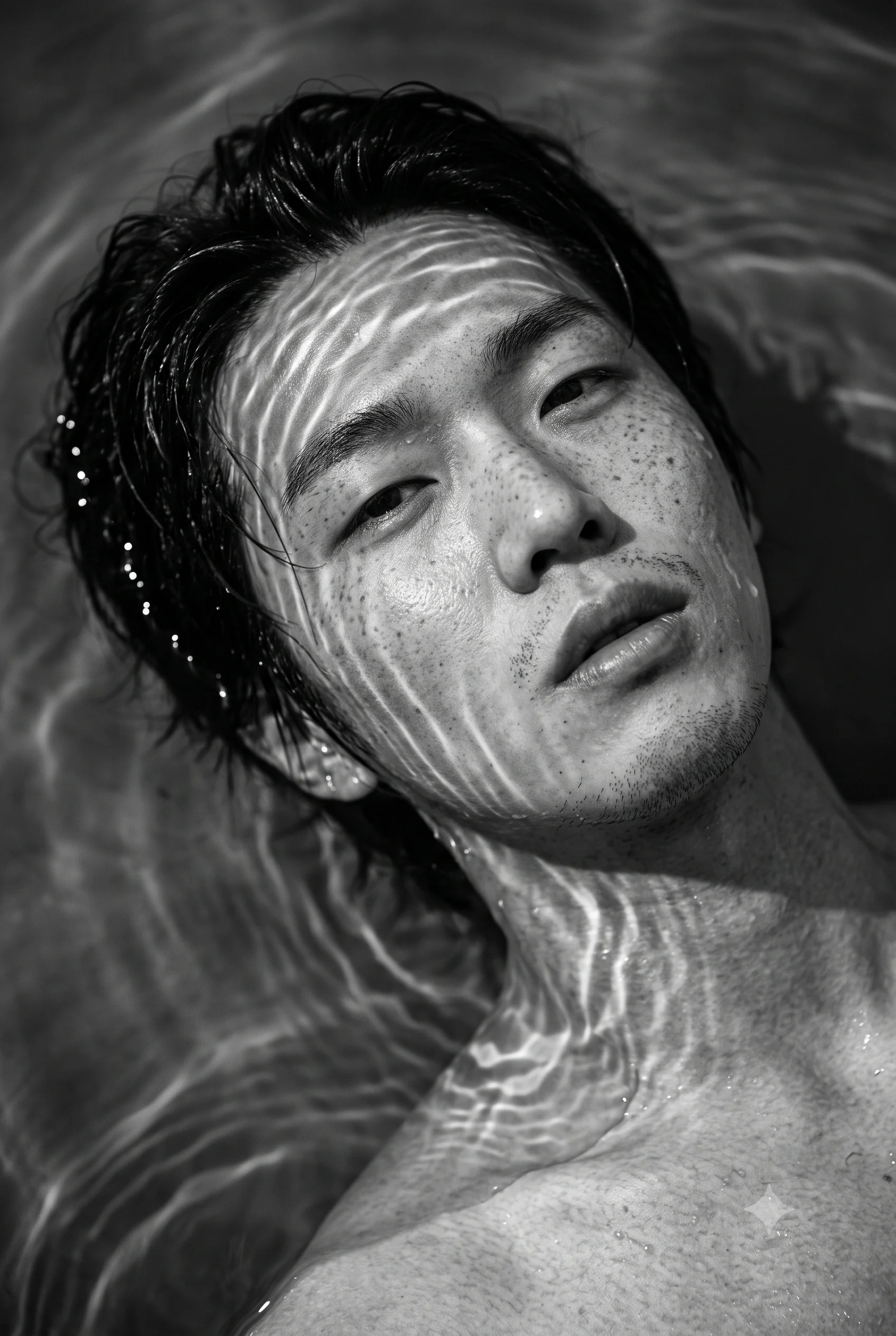
Copy-Paste AI Photo Editing Prompt
Use the uploaded image as the PRIMARY VISUAL REFERENCE. Recreate the underlying photograph as closely as possible. Match the exact composition, extreme close-up framing, head rotation, facial angle, wet hair, facial expression, water-light patterns, monochrome treatment, lighting direction, tonal range, background, and photographic texture. Do not create a different interpretation. Remove every piece of text and graphic design from the reference. Generate ONLY the clean photograph.
CORE CONCEPT
Create an ultra-photorealistic black-and-white cinematic close-up portrait of a young adult man with wet dark hair, natural freckles, subtle facial hair, and textured wet skin, photographed from an unusual diagonal angle.
The image should feel like the subject is partially submerged or surrounded by rippling water, with bright, irregular reflections from moving water projected across his face, neck, and upper body.
The result must look like a real high-end monochrome editorial photograph, not CGI, illustration, or a digital filter.
1. EXACT COMPOSITION
Reproduce the reference composition very closely.
The portrait is an extreme close-up.
The man's face occupies most of the frame.
His head is positioned diagonally rather than vertically:

Top of head toward the upper-left
Chin and neck extend toward the lower-right
Face fills approximately 65–75% of the frame
One side of the face is closer to the camera
Neck extends diagonally toward the lower-right corner
Only a small portion of the shoulders/upper torso is visible
Background surrounds the upper and right side of the head
Do NOT create a conventional centered portrait.
The diagonal head orientation is essential.
2. CAMERA ANGLE
Use an extreme close-up portrait perspective.
Camera is positioned very close to the subject's face and slightly below/sideways relative to his head.
Use approximately:
85mm–105mm macro/portrait lens aesthetic
with a very shallow depth of field.
The face should have realistic photographic perspective without wide-angle distortion.
The composition should feel intimate and slightly surreal because of the unusual camera orientation.
3. HEAD POSITION
Match the reference's head angle.
The subject's head is:

Tilted strongly sideways
Slightly reclined backward
Face turned toward camera
Chin angled toward the lower-right
Forehead toward upper-left
Neck stretched diagonally
Face occupying the dominant portion of the image
Do not straighten the head.
Do not make the subject face directly forward.
The diagonal orientation is one of the most important characteristics of the reference.
4. FACIAL EXPRESSION
Create a young adult male with a calm, dreamy, introspective expression.
His:

Eyes are partially open
Gaze is directed toward the camera
Eyelids relaxed
Lips slightly parted
Expression neutral and sensual but understated
Jaw relaxed
Do not make him smile.
Do not exaggerate the emotion.
The expression should feel quiet, mysterious, and dreamlike.
5. FACE DETAILS
Preserve highly realistic facial texture.
Include:

Clearly visible natural freckles across cheeks, nose and forehead
Natural pores
Fine skin texture
Subtle imperfections
Defined eyebrows
Natural eyelashes
Detailed iris
Slightly wet eyelashes
Natural lips
Short dark stubble
Fine beard texture along jaw and chin
The skin must NOT appear airbrushed.
Freckles are an important defining feature. Keep them visible.
6. HAIR
Recreate the reference's short dark wet hair.
Hair should be:

Dark brown/black
Wet
Slightly messy
Clumped naturally from moisture
Individual strands visible
Flattened in some areas
Slightly lifted in others
Glossy from water
Do not create perfectly styled dry hair.
Do not make the hair overly long.
The wet texture must be obvious.
7. WATER REFLECTIONS — MOST IMPORTANT ELEMENT
The defining visual feature is the bright rippling water-light projection across the man's face and body.
Create realistic caustic light patterns caused by sunlight or strong light passing through moving water.
The patterns should consist of:

Thin irregular white lines
Wavy parallel bands
Broken curved streaks
Uneven luminous shapes
Organic rippling patterns
Variable brightness
Natural distortion
Placement
The luminous water patterns should visibly travel across:

Forehead
Eyebrows
Upper cheeks
Nose
Lower cheek
Lips area
Jaw
Chin
Entire neck
Upper chest/shoulder
Some areas should have strong bright streaks.
Other areas should remain completely dark.
Do not make the lines perfectly straight.
Do not make them symmetrical.
Do not create repetitive digital stripes.
They must look like real underwater caustic reflections projected by moving water.
8. WATER BACKGROUND
The background should resemble a dark, calm water surface.
Behind the subject:

Deep gray/black water
Soft ripples
Subtle reflections
Small distorted highlights
Gentle circular wave patterns
A few bright elongated reflections near the top-right
The water should remain atmospheric and slightly out of focus.
Do not create a swimming pool with visible tiles.
Do not show obvious underwater scenery.
Keep the background minimal.
9. LIGHTING
Use a strong directional light filtered through moving water.
The light creates the bright caustic patterns on the subject.
Overall lighting:

High contrast
Deep shadows
Bright white highlights
Soft tonal transitions
Dramatic facial modeling
Strong highlight/shadow separation
The main illumination should appear to originate from above and slightly to one side.
The opposite side of the face should fall into soft shadow.
10. BLACK & WHITE
The entire photograph must be pure monochrome black and white.
Use:

Deep blacks
Charcoal midtones
Soft gray skin tones
Bright white water reflections
High dynamic range
No:

Pink
Blue
Green
Yellow
Brown
Skin-color tint
The image should resemble sophisticated fine-art black-and-white editorial photography.
11. TONAL BALANCE
Preserve the reference's dramatic tonal structure.

Highlights:
Bright, almost white water reflections.

Midtones:
Detailed facial skin, freckles, hair and beard.

Shadows:
Deep but not completely crushed.
The face must retain texture even inside darker areas.
Avoid excessive HDR.
Avoid artificial clarity.
12. SKIN & WATER DROPLETS
The subject appears wet.
Add subtle:

Water droplets
Tiny beads of moisture
Wet highlights
Moisture around the cheek
Slightly wet lips
Moisture on the neck
Keep droplets physically realistic.
Do not cover the face with large artificial droplets.
13. DEPTH OF FIELD
Use very shallow natural optical depth of field.

Sharpest:
Eyes, central facial features, freckles.

Slightly softer:
Edges of hair, ear, lower neck.

Softest:
Background water.
Maintain realistic lens falloff.
No artificial cutout effect.
14. CAMERA CHARACTER
Simulate a professional high-end camera photograph:

Full-frame sensor
85–105mm portrait lens
Wide aperture around f/1.8–f/2.2
High-resolution capture
Fine photographic grain
Natural highlight roll-off
Realistic lens rendering
Subtle optical softness
High micro-detail
The final image should look like a real editorial photograph captured in-camera.
15. EXACT REFERENCE PRIORITY
REFERENCE FIDELITY IS MORE IMPORTANT THAN CREATIVITY.
Preserve the reference's:
same diagonal composition
same head orientation
same extreme close-up
same face scale
same facial direction
same expression
same wet hairstyle
same freckles
same stubble
same neck position
same water-caustic pattern concept
same light direction
same dark water background
same monochrome treatment
same contrast
same depth of field
same cinematic atmosphere.
Do not introduce additional objects or change the composition.
16. REMOVE ALL TEXT & GRAPHICS
Completely remove:

“SeeDream”
“[prompt]”
All Russian text
English text
Captions
Logos
Watermarks
Usernames
Typography
Graphic overlays
Borders
Poster elements
Decorative text
Do not replace the removed text with anything.
The final output must be only the clean photograph.
FINAL GEMINI INSTRUCTION
Reconstruct the uploaded reference photograph itself rather than generating a generic underwater portrait. Preserve the unusual diagonal extreme close-up composition and the exact visual relationship between the man's face and the flowing water-light caustics. The water reflections must appear physically projected onto the skin, not digitally drawn. Ultra-photorealistic black-and-white fine-art photography, wet dark hair, natural freckles, realistic stubble, wet skin, dramatic caustic lighting, deep monochrome shadows, luminous rippling highlights, shallow depth of field, authentic camera optics, cinematic grain, 8K photographic detail, vertical 2:3 composition.
How to Use This Prompt in Google Gemini & ChatGPT
- Copy the exact prompt formula above.
- Open Google Gemini (Nano Banana Pro) or ChatGPT Vision and upload your reference portrait if required.
- Paste the prompt and adjust subject clothing or lighting details as desired.