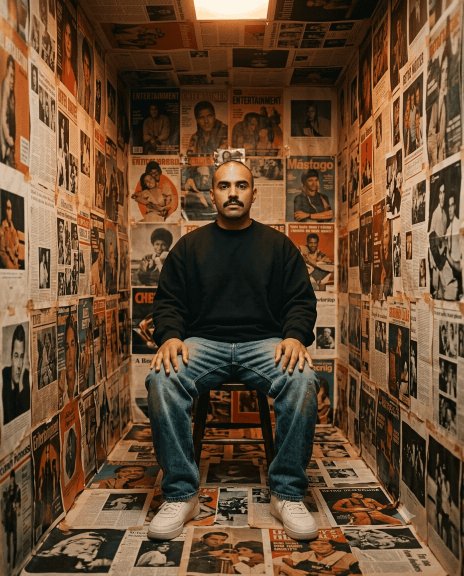
VINTAGE MAGAZINE ROOM CINEMATIC PORTRAIT
Category: Portraits | Optimized For: Gemini | Aspect Ratio: 4:5
Copy-Paste AI Photo Editing Prompt
Use the uploaded image as the sole identity reference. Create an ultra-realistic cinematic portrait of the same adult man shown in the uploaded image, seated on a simple stool inside a narrow rectangular room.

Preserve his recognizable identity with extremely high accuracy. Retain his exact facial structure, apparent age, skin tone, eye shape and color, eyebrows, nose, lips, cheekbones, jawline, chin, ears, hairline, hairstyle or natural hair characteristics, facial hair, and distinguishing facial details.

Do not redesign, idealize, or replace his face. Do not blend his identity with another person or introduce features resembling a celebrity or public figure. The final portrait must clearly depict the same individual as the uploaded reference.

Use the uploaded image for identity only. Do not copy its original pose, clothing, background, lighting, framing, image quality, or photographic artifacts unless they match the instructions below.

SUBJECT AND IDENTITY PRESERVATION
Reproduce the adult man from the uploaded reference with:

His exact face shape and facial proportions
His natural eye shape, spacing, color, and gaze
His original eyebrow shape, density, and placement
His exact nose, lips, cheekbones, jawline, and chin
His natural skin tone and undertone
His apparent adult age
His existing hairstyle, hairline, and hair texture
His natural facial-hair pattern, if present
Any permanent distinguishing facial characteristics
Maintain realistic skin with visible pores, fine lines, subtle blemishes, individual facial hairs, natural highlights, and minor human asymmetry. Preserve his recognizable appearance under the new cinematic lighting.

Dress him in:

A plain charcoal-black oversized crew-neck sweatshirt
Relaxed, faded blue jeans with subtle wear and natural fabric folds
Simple, clean off-white sneakers without branding
No jewelry, logos, writing, or recognizable symbols
Seat him near the center of the room on a modest dark wooden or metal stool. His legs should be naturally spread at a comfortable angle, with both feet planted securely on the floor.

Place his hands loosely between his knees or near his lap. Keep his shoulders relaxed and his fingers clearly visible, naturally posed, and anatomically correct.

He looks directly toward the camera with a calm, serious, slightly introspective expression. Preserve his natural personality and facial anatomy rather than forcing an exaggerated fashion expression.

ENVIRONMENT
Construct a compact, tunnel-like rectangular room with close parallel walls, a low ceiling, and a visible floor.

Completely cover the left wall, right wall, rear wall, ceiling, and visible floor with densely layered fictional vintage print material, including:

Aged entertainment-magazine covers
Retro portrait photography featuring invented people
Fictional music and cinema advertisements
Fashion-editorial fragments
Newspaper-style columns
Halftone images
Abstract graphic blocks
Torn paper edges
Folded and curling corners
Faded red, orange, cream, black, olive, and brown ink
Creases, wrinkles, tape marks, glue stains, scratches, and discoloration
The layered print material should feel physically attached to the room. Show believable paper thickness, overlapping edges, shadows beneath lifted corners, old adhesive, uneven aging, and subtle surface reflections.

Extend the collage continuously across every architectural surface so the man appears surrounded by a dense archive of forgotten popular culture.

Preserve clear converging perspective lines along the walls, ceiling, and floor, all leading toward the seated subject.

FICTIONAL PRINT-MATERIAL REQUIREMENT
Every magazine design, portrait, headline, photograph, advertisement, title, logo, and typographic element must be newly invented and completely fictional.

Do not reproduce or closely imitate:

Real magazine covers
Real newspapers
Existing entertainment publications
Celebrities or public figures
Real musicians, actors, or models
Recognizable films or television programs
Existing advertisements
Brand logos or trademarks
Copyrighted photographs or poster layouts
Legible real-world headlines
Text should appear only as:

Tiny abstract editorial marks
Illegible pseudo-lettering
Fragmented typographic textures
Nonsensical fictional glyphs
Partially obscured print patterns
Avoid coherent names, headlines, sentences, publication titles, dates, or brand references. The printed faces must be fictional and must not duplicate the seated man’s face.

COMPOSITION
Use a centered, nearly symmetrical composition photographed from a low camera position close to floor level.

Frame the subject full-body, showing him from his shoes to slightly above his head while including significant portions of the surrounding walls, floor, and ceiling.

Use a moderately wide 28–35mm cinematic lens aesthetic to emphasize the narrow room’s depth without creating fisheye distortion or unnaturally stretching the man’s face, head, hands, shoes, or body.

The side walls should create strong converging lines that guide attention toward the seated figure. Keep the architecture balanced and nearly symmetrical while retaining subtle real-world imperfection.

The man must remain the primary focal point, but the paper textures and environmental details should remain clearly visible. Keep the stool partially visible beneath him and physically connected to the floor.

Maintain believable scale relationships between the subject, stool, room, and printed pages.

POSE
Position the man naturally and comfortably:

Seated upright near the center of the room
Torso facing mostly toward the camera
Shoulders relaxed and level
Legs separated at a natural angle
Knees positioned slightly forward
Both feet fully touching the floor
Hands resting loosely between the knees or near the lap
Fingers relaxed, separate, and anatomically accurate
Head facing the camera
Direct but calm eye contact
Serious, quiet, introspective expression
Do not change his facial proportions to fit the pose. Avoid an exaggerated fashion stance, aggressive expression, unnatural slouch, or overly rigid posture.

LIGHTING
Use a warm amber practical light positioned near the front-center of the low ceiling.

Allow the overhead light to illuminate:

The forehead and upper face
Eyes and cheekbones
Nose and lips
Shoulders and upper torso
Hands and fingers
Knees and upper legs
Portions of the stool and floor
Create soft, physically believable shadows beneath:

Eyebrows and eye sockets
Nose
Lower lip and chin
Jawline
Arms and hands
Knees
Stool and shoes
Raised and overlapping paper edges
Add subtle reflected light from the orange, cream, and faded-red magazine pages. Keep the corners, lower edges, and upper rear portion of the room slightly darker to create a natural tunnel-like vignette.

The eyes should remain visible and correctly exposed. Do not allow the overhead light to erase his facial details, alter his identity, or create unnaturally black eye sockets.

Use realistic light falloff, soft atmospheric depth, and restrained highlight bloom.

COLOR GRADING
Apply a nostalgic cinematic palette featuring:

Burnt orange
Faded cream
Rust red
Tobacco brown
Muted olive
Charcoal black
Desaturated denim blue
Introduce restrained teal tones in the deepest shadows for subtle cinematic contrast while keeping warm amber as the dominant atmosphere.

Add:

Subtle analog film grain
Soft halation around bright highlights
Gently faded print colors
Controlled shadow noise
Slightly lifted vintage blacks
Natural skin-tone separation
Moderate editorial contrast
Subtle optical softness away from the focal plane
Avoid an excessive orange filter. The subject’s actual skin tone must remain accurate and recognizable beneath the warm lighting.

CAMERA AND PHOTOGRAPHIC DIRECTION
Use the aesthetic of a professional cinematic editorial photograph captured with:

A 28–35mm full-frame cinematic lens
Low camera height near floor level
Centered camera placement
Deep linear perspective
Medium depth of field
Sharp focus on the subject’s eyes and face
Detailed but slightly softer background layers
High dynamic range
Realistic lens rendering
Minimal barrel distortion
Physically accurate shadows and reflections
Maintain natural facial proportions despite the moderately wide lens. Do not place the camera so close that the nose, head, hands, knees, or shoes become exaggerated.

Render realistic material detail in:

Skin
Facial hair
Sweatshirt fabric
Denim
Sneakers
Paper fibers
Ink
Tape
Glue residue
Wooden or metal stool surfaces
Floor texture
Use premium editorial retouching that preserves pores, fine lines, fabric texture, and analog character.

FINAL AESTHETIC
The final image should feel like:

A mysterious independent-film still
An underground music editorial
A vintage cultural archive
A conceptual portrait about memory, media, identity, and nostalgia
A carefully constructed practical set photographed with real cinematic lighting
The image must look like authentic production photography, not a digital illustration, painted artwork, composite error, or synthetic CGI environment.

Render in Ultra-HD 8K photorealistic quality.

ASPECT RATIO: VERTICAL 4:5

NEGATIVE PROMPT
Do not change, replace, beautify, or reinterpret the identity of the man in the uploaded reference.

No identity drift, invented face, face blending, face swapping, unrelated person, celebrity transformation, public-figure transformation, or resemblance to anyone other than the uploaded subject.

No changes to his apparent age, ethnicity, skin tone, eye color, eye shape, facial proportions, eyebrows, nose, lips, cheekbones, jawline, chin, ears, hairstyle, hairline, or facial-hair pattern.

No recognizable magazine covers, real newspapers, copyrighted photographs, real celebrities, real musicians, real actors, public figures, brand names, publication logos, movie posters, album covers, copied headlines, trademarks, or readable real-world text.

No duplicated pages, repeated faces, duplicated portraits, cloned collage sections, extra people, background figures appearing alive, or printed faces that resemble the seated subject.

No malformed hands, missing fingers, extra fingers, fused fingers, twisted wrists, duplicated limbs, fused legs, disconnected feet, floating shoes, impossible posture, or unnatural joints.

No floating stool, missing stool legs, incorrect contact shadows, warped walls, curved room geometry, broken perspective, inconsistent vanishing points, impossible ceiling height, or fisheye facial distortion.

No plastic skin, waxy texture, excessive smoothing, artificial pores, over-sharpening, exaggerated muscles, glamorized facial reconstruction, or loss of distinguishing features.

No oversaturated orange tones, crushed black facial detail, blown highlights, unnatural teal skin, random illumination, incorrect shadow directions, excessive bloom, or heavy artificial vignette.

No cartoon style, illustration, painting, anime, 3D render, obvious CGI, collage cutout effect, low-resolution paper textures, or synthetic-looking fabric.

No jewelry, visible logos, branded clothing, shoe branding, readable writing on clothing, watermarks, signatures, captions, prompt text, timestamps, borders, app controls, editing handles, or UI elements.
How to Use This Prompt in Google Gemini & ChatGPT
- Copy the exact prompt formula above.
- Open Google Gemini (Nano Banana Pro) or ChatGPT Vision and upload your reference portrait if required.
- Paste the prompt and adjust subject clothing or lighting details as desired.