PINK BLAZER & WHITE ROSE
Category: Portraits | Optimized For: Gemini | Aspect Ratio: 4:5
Copy-Paste AI Photo Editing Prompt
PINK BLAZER & WHITE ROSE
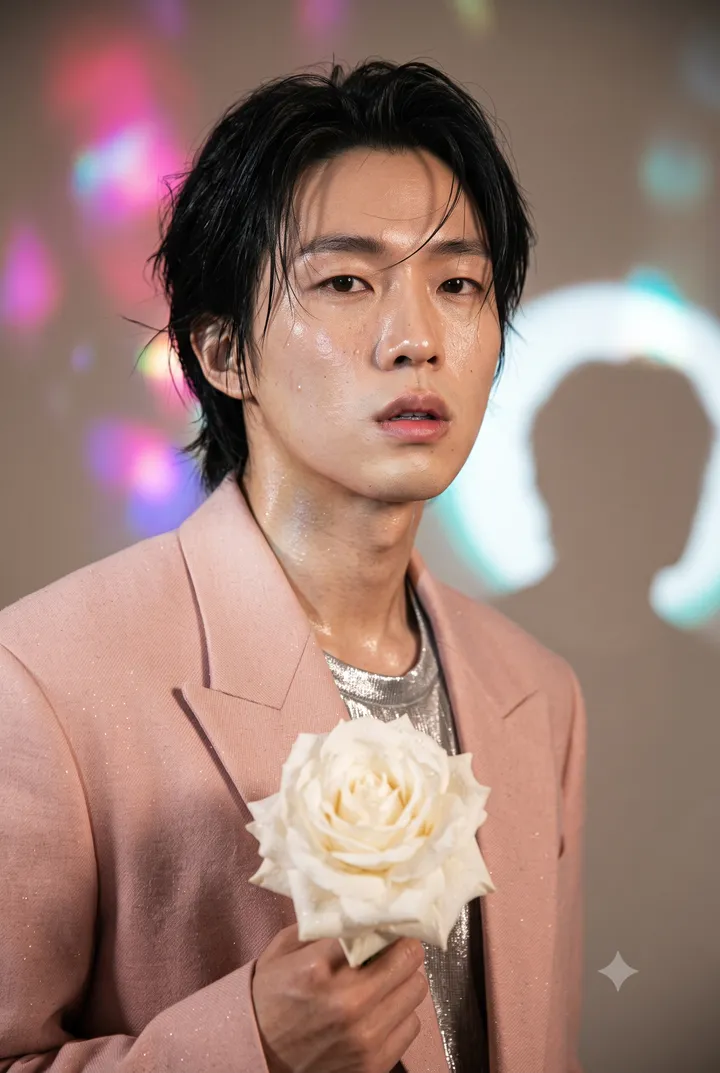
Use the uploaded image as the PRIMARY AND DOMINANT VISUAL REFERENCE. Recreate the actual photograph shown in the reference, not merely the same aesthetic. The final image must closely match the reference in composition, framing, camera position, perspective, body position, head angle, facial direction, hair arrangement, clothing shape, rose placement, lighting, shadows, background, bokeh, and color grading.
Do not redesign, reinterpret, beautify, or change the photographic composition. Treat the uploaded image as a strict photographic blueprint.
1. COMPOSITION — MATCH THE REFERENCE EXACTLY
Create a vertical 2:3 fashion portrait.
The subject occupies almost the entire frame.
The composition should match the reference:

Head positioned approximately in the upper-center area
Hair extends toward the upper edge of the image
Face occupies the central upper portion
Shoulders extend widely toward both sides
Left shoulder reaches close to the left edge
Right shoulder extends toward the right edge
Torso is visible down to the lower frame
Large white rose occupies the lower-center/right foreground
Rose partially covers the blazer and lower torso
Subject is NOT standing straight toward camera
Body is angled approximately 3/4 toward the camera
Head is slightly tilted backward/upward
Face remains the dominant focal point
Do not center the entire body symmetrically.
The reference has an intentionally off-balance editorial composition. Preserve that.
2. CAMERA ANGLE
Reproduce the reference camera perspective.
Camera is positioned approximately at the subject's upper chest/face level, with a subtle upward perspective.
Use a portrait lens approximately equivalent to:
85mm full-frame
with:
f/1.8–f/2.2
Do NOT use an exaggerated wide-angle lens.
Do NOT make the head disproportionately large.
Do NOT create a flat passport-style portrait.
The image should have realistic optical compression similar to the reference photograph.
3. SUBJECT POSITION
Create a young adult East Asian male fashion model.
His body is turned slightly sideways while his face turns toward the camera.

Exact posture:
Shoulders angled rather than perfectly horizontal
Upper torso leaning subtly
Neck elongated
Chin slightly elevated
Head tilted slightly backward
Face turned slightly toward camera
Eyes looking toward the camera
Mouth naturally slightly open
Expression subtle, calm, mysterious and slightly surprised
Do not change the pose into a conventional standing portrait.
4. FACE — PRESERVE THE REFERENCE STRUCTURE
The face should resemble the facial proportions and orientation visible in the uploaded reference.
Preserve:

Narrow/oval facial structure
High cheekbone appearance
Defined jawline
Natural nose shape
Slightly full lips
Narrow eyes
Eyebrow position
Facial angle
Head rotation
Neck position
The face should NOT become:

smiling
aggressively masculine
overly feminine
cartoon-like
plastic
airbrushed
symmetrical AI beauty-face
Maintain realistic human asymmetry.
5. HAIR — VERY IMPORTANT
The hairstyle is one of the defining elements of the reference.
Recreate:
medium-length black hair with substantial volume and messy layered styling.
Hair should:

Sweep upward and backward
Have several long strands falling across the forehead
Have strands crossing partially over the eyes
Have irregular separated strands
Create volume around the top of the head
Have slightly wet/glossy texture
Look naturally messy rather than perfectly styled
Do not create a clean Korean comma hairstyle.
Do not expose the entire forehead.
Do not shorten the hair.
The loose strands crossing the face are essential to matching the reference.
6. SKIN & FACE LIGHTING
The reference has a distinctive wet/glossy skin appearance.
Recreate:

Glossy cheekbone
Strong highlight on nose
Gloss on upper lip
Moisture-like highlight around cheeks
Glossy neck
Subtle sheen on forehead
Natural pores
Fine skin texture
The skin must remain realistic.
Do not apply excessive beauty retouching.
The highlight should appear photographically captured, not painted onto the skin.
7. PINK BLAZER — MATCH THE REFERENCE
The subject wears a large structured pastel dusty-pink blazer.
Match:

Oversized silhouette
Broad shoulders
Wide lapels
Double-breasted/structured fashion appearance
Soft dusty pink color
Visible woven fabric
Slight sparkling texture
Natural folds around elbows and torso
The blazer should occupy a significant percentage of the lower half of the image.
Underneath the blazer is a shimmering silver/light metallic garment visible around the neck and chest.
Do not replace it with a plain white shirt.
8. WHITE ROSE — CRITICAL
The rose must be positioned almost exactly like the reference.
Create one very large white rose.
Position it:
in the lower foreground, slightly right of center, directly in front of the subject's chest.
The rose should be:

Large
Very close to camera
Slightly out of focus compared with the face
Creamy white
Covered with tiny water droplets
Composed of many natural overlapping petals
The rose should obscure part of the blazer.

Important:
Do not place the rose beside the face.
Do not make it a small bouquet.
Do not create multiple roses.
Do not put the rose at the bottom center completely.
Its position and scale must closely follow the uploaded reference.
9. BACKGROUND — MATCH THE LIGHT PATTERN
The background is a muted gray/beige interior wall.
Do NOT create a studio backdrop.
Do NOT create a colorful abstract background.
Reproduce the physical wall appearance.
Behind the subject are strongly defocused colorful light reflections.
Include several distinct areas:

Left side
Near the upper-left/mid-left background:

blurred pink
purple
blue
green
yellow light blobs
These should appear irregular and organically reflected.

Right side
Behind the subject's right shoulder:

large pale cyan/white circular bokeh
overlapping green
cyan
yellow
pink light reflections
The colorful lights must remain behind the subject, never overlaid on his face.
10. SHADOW — IMPORTANT
The reference contains a strong physical shadow cast behind the subject.
Create a visible dark human-shaped shadow on the wall behind him.
The shadow should originate from the directional light hitting the subject.
It must look like a real optical shadow, not a digital effect.
Preserve the relationship between:
subject → light source → cast shadow → wall.
11. LIGHTING GEOMETRY
Use one strong directional light coming from approximately the front-left/upper-left direction.
The light creates:

bright facial highlights
darker opposite facial side
strong neck shadow
blazer highlights
physical wall shadow
glossy skin reflections
Add very soft ambient fill.
Do not flatten the lighting.
Do not use standard beauty lighting.
The contrast between illuminated skin and shadow is essential to the reference.
12. DEPTH OF FIELD
Use strong but realistic shallow depth of field.

Sharpest area:
Eyes / face

Slightly softer:
Hair edges and blazer

Much softer:
Background

Foreground:
The large rose should have partial optical softness, while some front petals remain recognizable.
Create authentic lens depth rather than artificial Gaussian blur.
13. COLOR & IMAGE CHARACTER
Match the reference's photographic color palette:

Dusty blush pink blazer
Warm beige/gray wall
Warm skin
Cool cyan
Neon green
Magenta
Soft yellow
Cream-white rose
Keep the colors slightly muted except for the colorful background reflections.
Add subtle:

film grain
lens bloom
chromatic optical character
highlight roll-off
photographic noise
natural HDR
The final image must look like a real high-end fashion photograph, not an AI illustration.
14. MOST IMPORTANT INSTRUCTION
Do not create a new interpretation of this concept.
COPY THE VISUAL STRUCTURE OF THE UPLOADED IMAGE.
Match the following as closely as possible:
same framing
same crop
same camera distance
same camera height
same perspective
same head position
same head tilt
same facial direction
same hair silhouette
same body rotation
same shoulder position
same blazer proportions
same rose size
same rose location
same background
same bokeh locations
same shadow direction
same lighting direction
same contrast
same color relationships
same depth of field
same cinematic photographic character.
Only remove the graphic/textual elements.
15. REMOVE ALL GRAPHICS
ABSOLUTELY DO NOT GENERATE:

Russian text
English text
title
captions
Telegram text
watermark
logo
username
typography
poster layout
border
decorative graphic elements
UI elements
text overlays
Generate ONLY the clean photograph.
FINAL GEMINI COMMAND
Reference fidelity is more important than creativity. Do not invent a different pose, different camera angle, different hairstyle, different rose position, different lighting setup, or different background. Reconstruct the uploaded photograph itself as closely as possible, while removing all text and graphic elements.
Ultra-photorealistic professional fashion photography, realistic human anatomy, authentic skin pores, individual hair strands, physically accurate shadows, real optical bokeh, realistic lens behavior, high dynamic range, subtle film grain, 8K photographic detail, 2:3 vertical composition.You're right. The previous prompt was too generic. It described the style, but it did not force Gemini to reproduce the exact composition, camera angle, subject proportions, pose, rose placement, and lighting geometry of your reference.
Use this stricter version:

EXACT REFERENCE RECREATION — PINK BLAZER & WHITE ROSE
GEMINI IMAGE-TO-IMAGE PROMPT
Use the uploaded image as the PRIMARY AND DOMINANT VISUAL REFERENCE. Recreate the actual photograph shown in the reference, not merely the same aesthetic. The final image must closely match the reference in composition, framing, camera position, perspective, body position, head angle, facial direction, hair arrangement, clothing shape, rose placement, lighting, shadows, background, bokeh, and color grading.
Do not redesign, reinterpret, beautify, or change the photographic composition. Treat the uploaded image as a strict photographic blueprint.
1. COMPOSITION — MATCH THE REFERENCE EXACTLY
Create a vertical 2:3 fashion portrait.
The subject occupies almost the entire frame.
The composition should match the reference:

Head positioned approximately in the upper-center area
Hair extends toward the upper edge of the image
Face occupies the central upper portion
Shoulders extend widely toward both sides
Left shoulder reaches close to the left edge
Right shoulder extends toward the right edge
Torso is visible down to the lower frame
Large white rose occupies the lower-center/right foreground
Rose partially covers the blazer and lower torso
Subject is NOT standing straight toward camera
Body is angled approximately 3/4 toward the camera
Head is slightly tilted backward/upward
Face remains the dominant focal point
Do not center the entire body symmetrically.
The reference has an intentionally off-balance editorial composition. Preserve that.
2. CAMERA ANGLE
Reproduce the reference camera perspective.
Camera is positioned approximately at the subject's upper chest/face level, with a subtle upward perspective.
Use a portrait lens approximately equivalent to:
85mm full-frame
with:
f/1.8–f/2.2
Do NOT use an exaggerated wide-angle lens.
Do NOT make the head disproportionately large.
Do NOT create a flat passport-style portrait.
The image should have realistic optical compression similar to the reference photograph.
3. SUBJECT POSITION
Create a young adult East Asian male fashion model.
His body is turned slightly sideways while his face turns toward the camera.

Exact posture:
Shoulders angled rather than perfectly horizontal
Upper torso leaning subtly
Neck elongated
Chin slightly elevated
Head tilted slightly backward
Face turned slightly toward camera
Eyes looking toward the camera
Mouth naturally slightly open
Expression subtle, calm, mysterious and slightly surprised
Do not change the pose into a conventional standing portrait.
4. FACE — PRESERVE THE REFERENCE STRUCTURE
The face should resemble the facial proportions and orientation visible in the uploaded reference.
Preserve:

Narrow/oval facial structure
High cheekbone appearance
Defined jawline
Natural nose shape
Slightly full lips
Narrow eyes
Eyebrow position
Facial angle
Head rotation
Neck position
The face should NOT become:

smiling
aggressively masculine
overly feminine
cartoon-like
plastic
airbrushed
symmetrical AI beauty-face
Maintain realistic human asymmetry.
5. HAIR — VERY IMPORTANT
The hairstyle is one of the defining elements of the reference.
Recreate:
medium-length black hair with substantial volume and messy layered styling.
Hair should:

Sweep upward and backward
Have several long strands falling across the forehead
Have strands crossing partially over the eyes
Have irregular separated strands
Create volume around the top of the head
Have slightly wet/glossy texture
Look naturally messy rather than perfectly styled
Do not create a clean Korean comma hairstyle.
Do not expose the entire forehead.
Do not shorten the hair.
The loose strands crossing the face are essential to matching the reference.
6. SKIN & FACE LIGHTING
The reference has a distinctive wet/glossy skin appearance.
Recreate:

Glossy cheekbone
Strong highlight on nose
Gloss on upper lip
Moisture-like highlight around cheeks
Glossy neck
Subtle sheen on forehead
Natural pores
Fine skin texture
The skin must remain realistic.
Do not apply excessive beauty retouching.
The highlight should appear photographically captured, not painted onto the skin.
7. PINK BLAZER — MATCH THE REFERENCE
The subject wears a large structured pastel dusty-pink blazer.
Match:

Oversized silhouette
Broad shoulders
Wide lapels
Double-breasted/structured fashion appearance
Soft dusty pink color
Visible woven fabric
Slight sparkling texture
Natural folds around elbows and torso
The blazer should occupy a significant percentage of the lower half of the image.
Underneath the blazer is a shimmering silver/light metallic garment visible around the neck and chest.
Do not replace it with a plain white shirt.
8. WHITE ROSE — CRITICAL
The rose must be positioned almost exactly like the reference.
Create one very large white rose.
Position it:
in the lower foreground, slightly right of center, directly in front of the subject's chest.
The rose should be:

Large
Very close to camera
Slightly out of focus compared with the face
Creamy white
Covered with tiny water droplets
Composed of many natural overlapping petals
The rose should obscure part of the blazer.

Important:
Do not place the rose beside the face.
Do not make it a small bouquet.
Do not create multiple roses.
Do not put the rose at the bottom center completely.
Its position and scale must closely follow the uploaded reference.
9. BACKGROUND — MATCH THE LIGHT PATTERN
The background is a muted gray/beige interior wall.
Do NOT create a studio backdrop.
Do NOT create a colorful abstract background.
Reproduce the physical wall appearance.
Behind the subject are strongly defocused colorful light reflections.
Include several distinct areas:

Left side
Near the upper-left/mid-left background:

blurred pink
purple
blue
green
yellow light blobs
These should appear irregular and organically reflected.

Right side
Behind the subject's right shoulder:

large pale cyan/white circular bokeh
overlapping green
cyan
yellow
pink light reflections
The colorful lights must remain behind the subject, never overlaid on his face.
10. SHADOW — IMPORTANT
The reference contains a strong physical shadow cast behind the subject.
Create a visible dark human-shaped shadow on the wall behind him.
The shadow should originate from the directional light hitting the subject.
It must look like a real optical shadow, not a digital effect.
Preserve the relationship between:
subject → light source → cast shadow → wall.
11. LIGHTING GEOMETRY
Use one strong directional light coming from approximately the front-left/upper-left direction.
The light creates:

bright facial highlights
darker opposite facial side
strong neck shadow
blazer highlights
physical wall shadow
glossy skin reflections
Add very soft ambient fill.
Do not flatten the lighting.
Do not use standard beauty lighting.
The contrast between illuminated skin and shadow is essential to the reference.
12. DEPTH OF FIELD
Use strong but realistic shallow depth of field.

Sharpest area:
Eyes / face

Slightly softer:
Hair edges and blazer

Much softer:
Background

Foreground:
The large rose should have partial optical softness, while some front petals remain recognizable.
Create authentic lens depth rather than artificial Gaussian blur.
13. COLOR & IMAGE CHARACTER
Match the reference's photographic color palette:

Dusty blush pink blazer
Warm beige/gray wall
Warm skin
Cool cyan
Neon green
Magenta
Soft yellow
Cream-white rose
Keep the colors slightly muted except for the colorful background reflections.
Add subtle:

film grain
lens bloom
chromatic optical character
highlight roll-off
photographic noise
natural HDR
The final image must look like a real high-end fashion photograph, not an AI illustration.
14. MOST IMPORTANT INSTRUCTION
Do not create a new interpretation of this concept.
COPY THE VISUAL STRUCTURE OF THE UPLOADED IMAGE.
Match the following as closely as possible:
same framing
same crop
same camera distance
same camera height
same perspective
same head position
same head tilt
same facial direction
same hair silhouette
same body rotation
same shoulder position
same blazer proportions
same rose size
same rose location
same background
same bokeh locations
same shadow direction
same lighting direction
same contrast
same color relationships
same depth of field
same cinematic photographic character.
Only remove the graphic/textual elements.
15. REMOVE ALL GRAPHICS
ABSOLUTELY DO NOT GENERATE:

Russian text
English text
title
captions
Telegram text
watermark
logo
username
typography
poster layout
border
decorative graphic elements
UI elements
text overlays
Generate ONLY the clean photograph.
FINAL GEMINI COMMAND
Reference fidelity is more important than creativity. Do not invent a different pose, different camera angle, different hairstyle, different rose position, different lighting setup, or different background. Reconstruct the uploaded photograph itself as closely as possible, while removing all text and graphic elements.
Ultra-photorealistic professional fashion photography, realistic human anatomy, authentic skin pores, individual hair strands, physically accurate shadows, real optical bokeh, realistic lens behavior, high dynamic range, subtle film grain, 8K photographic detail, 2:3 vertical composition.
How to Use This Prompt in Google Gemini & ChatGPT
- Copy the exact prompt formula above.
- Open Google Gemini (Nano Banana Pro) or ChatGPT Vision and upload your reference portrait if required.
- Paste the prompt and adjust subject clothing or lighting details as desired.