ORANGE-AND-BLACK SCULPTURAL FACE RELIEF
Category: Portraits | Optimized For: Gemini | Aspect Ratio: 4:5
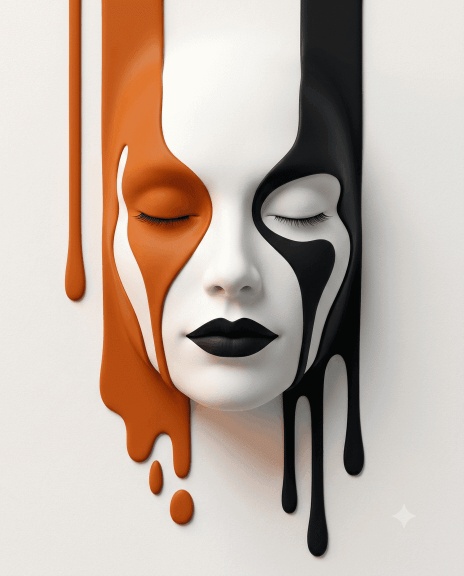
Copy-Paste AI Photo Editing Prompt
Use the uploaded identity image as the exact facial reference for the adult subject. Translate the subject’s recognizable facial geometry into a smooth minimalist 3D relief while preserving the brow shape, closed-eye contours, nose structure, cheek proportions, lip shape, chin, jawline, facial width, natural asymmetry, and apparent age.

Because hair, ears, neck, skin color, and open eyes will not be shown, preserve identity primarily through the subject’s facial proportions, brow placement, eyelid shape, nose, philtrum, lips, cheek contours, chin, and jaw. Do not substitute a generic symmetrical face, alter the subject’s proportions excessively, or beautify the relief into an unrelated idealized identity.

Use the supplied composition reference only for the centered facial relief, closed eyes, vertical orange-and-black forms, rounded drips, white background, material treatment, and minimalist composition. Create a new arrangement. Do not copy any recognizable artwork, sculpture, graphic layout, typography, title, logo, watermark, or exact arrangement from the reference.

Create a premium minimalist 3D artwork featuring a sculptural likeness of the uploaded adult subject emerging gradually from a smooth off-white vertical wall or canvas. The forehead, brow, closed eyelids, nose, cheeks, lips, chin, and jaw should rise gently from the surface as a shallow-to-medium relief rather than a detached head.

Do not include visible hair, ears, neck, shoulders, clothing, or a separate head shape. Blend the outer forehead, temples, cheeks, jaw, and chin seamlessly back into the white surface. Keep the expression peaceful, neutral, introspective, and meditative.

FACIAL RELIEF
Keep both eyes fully closed. Preserve the uploaded subject’s eyelid shape, spacing, brow structure, and nose proportions. Add delicate matte-black eyelashes with individually defined but restrained fibers.

Render the lips in deep matte black while preserving the subject’s recognizable lip shape, cupid’s bow, width, volume, and natural asymmetry. Add subtle sculptural texture without making the lips glossy, detached, or misplaced.

Keep the central facial area predominantly off-white. Use smooth transitions around the brow, nose bridge, nostrils, cheeks, philtrum, lips, chin, and jaw. Avoid exaggerated symmetry, distorted anatomy, an overly narrow nose, or generic mannequin-like proportions.

LEFT ORANGE FORM
Create one tall burnt-orange sculptural form descending vertically along the left side of the composition. Begin the form beyond the upper frame edge, widen it around the left brow, closed eye, temple, and cheek, narrow it near the jaw, and continue it downward into rounded paint-like drips.

Shape the orange material around the closed left eye so part of the white facial relief remains clearly visible beneath or beside it. Do not cover the central nose, lips, or entire eye contour.

Add one narrower orange extension near the far-left edge with rounded ends, realistic depth, and a different length from the main orange drip. Keep the secondary form connected visually to the overall composition without creating random detached shapes.

RIGHT BLACK FORM
Create a contrasting matte-black sculptural form descending vertically along the right side. Begin it beyond the upper frame edge, widen it around the right temple, closed eye, cheek, and outer jaw, and extend it below the chin into two long rounded drips of different lengths.

Shape the black material to frame the right eye and side of the face without covering the central nose or matte-black lips. Maintain enough white relief around the eyelid, cheek, and jaw to preserve the uploaded subject’s facial geometry.

Add one small secondary matte-black extension near the lower-right region to balance the narrow orange extension on the opposite side. Keep it organically integrated into the composition.

MATERIALS AND COLOR SEPARATION
Make the orange and black forms appear like a refined combination of flowing paint, soft rubber, carved resin, and molded sculptural material. Give them smooth rounded edges, realistic thickness, subtle surface texture, and coherent contact with the wall.

The shapes should appear solid and deliberately sculpted rather than wet, unstable, biological, or made from melting flesh. Avoid jagged edges, splashes, sharp points, or chaotic drips.

Maintain clear material and color separation:

Saturated burnt orange on the left
Deep matte black on the right
Soft off-white across the central facial relief
Restrained neutral-gray shadows
Do not introduce unrelated colors, rainbow effects, metallic accents, or neon gradients.

BACKGROUND AND LIGHTING
Use a clean off-white background with a delicate paper, plaster, or fine-canvas texture. Keep the environment completely minimal and free from furniture, architecture, decorative objects, or additional artwork.

Add faint contact shadows beneath the raised facial features and colored forms to emphasize realistic physical depth. Use accurate ambient occlusion around the nostrils, lips, eyelids, chin, and edges of the orange and black materials.

Illuminate the sculpture with one large diffused frontal light positioned slightly above. Add soft gray shadows beneath the brow, nose, lips, chin, and raised colored edges. Introduce a restrained warm reflection near the orange form and cooler neutral shadows near the black form.

Use an extremely limited palette of burnt orange, pure matte black, soft white, and neutral gray. Keep the orange saturated and refined rather than fluorescent.

The finished artwork should communicate emotional duality, opposing energies, balance, identity, silence, inner conflict, transformation, and harmony. Present it as a premium contemporary art installation, luxury editorial cover image, or minimalist interior-art piece.

High-end 3D sculptural rendering combined with photorealistic product photography, centered composition, intentional asymmetry in the flowing forms, crisp rounded edges, realistic material response, ambient occlusion, soft global illumination, high dynamic range, subtle surface texture, and Ultra-HD 8K quality.

Strong sculptural identity fidelity to the uploaded image; exactly one facial relief; no identity drift, generic face substitution, excessive beautification, copied artwork, recognizable existing sculpture, open eyes, extra eyes, duplicated noses, misplaced lips, detached facial parts, distorted anatomy, visible hair, ears, neck, shoulders, gore, melting flesh, injury, blood, body horror, sharp edges, random colors, text overlay, title, social-media information, logos, watermark, border, or application-interface elements. Vertical 4:5 aspect ratio.
How to Use This Prompt in Google Gemini & ChatGPT
- Copy the exact prompt formula above.
- Open Google Gemini (Nano Banana Pro) or ChatGPT Vision and upload your reference portrait if required.
- Paste the prompt and adjust subject clothing or lighting details as desired.