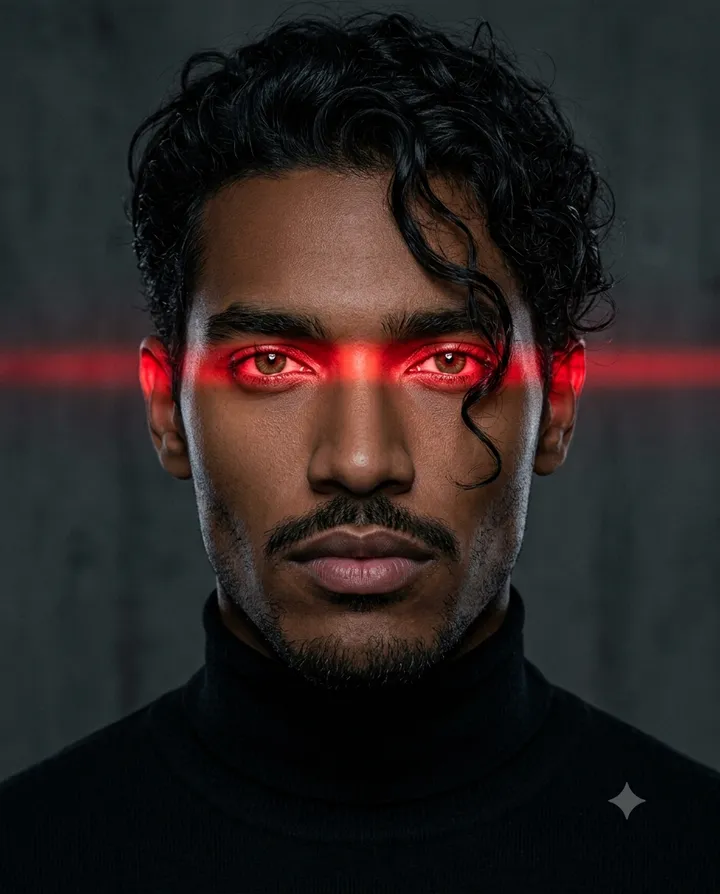
CRIMSON LIGHT-BAND CINEMATIC PORTRAIT
Category: Portraits | Optimized For: Gemini | Aspect Ratio: 4:5
Copy-Paste AI Photo Editing Prompt
COMPLETE GEMINI IMAGE-UPLOAD PROMPT
Use the uploaded image as the sole identity reference. Create an ultra-realistic cinematic close-up portrait of the same adult man shown in the uploaded photograph, facing the camera directly.

Preserve his recognizable identity with extremely high accuracy. Retain his exact facial structure, apparent age, skin tone, eye shape and color, eye spacing, eyebrows, nose, lips, cheekbones, jawline, chin, ears, hairline, facial-hair pattern, and distinguishing natural features.

Do not redesign, idealize, beautify, or replace his face. Do not merge his identity with another person or introduce features associated with a celebrity, public figure, influencer, or unrelated individual. The final result must clearly depict the same person as the uploaded reference.

Use the uploaded image for identity only. Do not copy its original pose, expression, clothing, background, lighting, framing, or photographic artifacts unless they match the following instructions.

SUBJECT AND IDENTITY PRESERVATION
Accurately preserve from the uploaded reference:

Exact face shape and facial proportions
Natural eye shape, spacing, color, and eyelid structure
Original eyebrow shape, thickness, and placement
Exact nose shape and proportions
Natural lip shape, fullness, and asymmetry
Cheekbones, jawline, chin, and ears
Skin tone, undertone, and natural tonal variation
Apparent adult age
Natural hairline and recognizable hair characteristics
Existing facial-hair growth pattern
Any permanent distinguishing facial characteristics
Preserve realistic skin detail, including visible pores, fine facial hairs, subtle under-eye texture, minor blemishes, natural highlights, and small human imperfections. Do not remove identity-defining details through excessive retouching.

If facial hair is present in the uploaded image, preserve its natural growth pattern while refining it into a carefully groomed mustache, short goatee, and subtle jaw stubble. If the reference has little or no facial hair, keep any added facial hair restrained, realistic, and compatible with his appearance rather than allowing it to alter his identity.

HAIR
Style his hair into a thick, black or naturally dark, wavy-to-curly editorial hairstyle while preserving the uploaded subject’s natural hairline, forehead proportions, hair color, and recognizable appearance.

Create an intentionally messy but professionally styled asymmetrical arrangement:

One side slightly shorter, tighter, and more controlled
The opposite side fuller and longer
Loose curls falling across one side of the forehead
One defined curl descending near an eye and upper cheek
Both eyes remaining clearly visible
Natural volume and curl separation
Individually rendered strands
Fine flyaway hairs
Subtle cool and red highlights
The hairstyle must appear physically plausible and connected to the scalp. Do not use a wig-like shape, duplicated curls, floating hair, or an unnaturally sharp hairline.

If the uploaded subject’s natural hair texture differs significantly, adapt the asymmetrical editorial styling in a way that remains believable for his real hair rather than completely replacing his natural characteristics.

WARDROBE
Dress him in a plain, fitted black ribbed turtleneck.

The garment should have:

Realistic fine ribbing
Natural fabric folds around the neck and shoulders
Deep charcoal-to-black tonal variation
Subtle light absorption
No logos
No patterns
No writing
No jewelry
No visible branding
Frame the portrait from the upper chest to slightly above the hair. Keep the shoulders square, the head upright, the chin neutral, and the lips naturally closed.

He should look directly into the camera with a calm but intensely focused gaze. Avoid an angry grimace, exaggerated frown, theatrical snarl, or unnatural facial tension.

CRIMSON LIGHT BAND
Project a narrow, precisely aligned horizontal band of vivid crimson-red light across both eyes.

The band must pass through:

Both irises and pupils
Upper and lower eyelids
Upper cheeks
Bridge and sides of the nose
Temples
Visible portions of the ears
Nearby hair strands
The background behind the subject
The effect must look like a controlled studio light projection, illuminated slit, or narrow strip of colored light. It must not look like lasers, energy beams, or supernatural light emerging from the eyes.

Both eyes must remain anatomically natural and clearly visible inside the illuminated strip.

Use:

A bright scarlet center
Deep crimson edges
Subtle red bloom around the eyelids
Realistic red reflections in the moisture of the eyes
Fine red highlights on eyelashes
Small red accents on nearby curls and flyaway hairs
Restrained red illumination on the bridge of the nose
Soft red spill across the upper cheeks
A continuous horizontal red line visible on the background
Allow the natural irises to shift optically toward pale gray, silver-brown, or muted hazel under the intense crimson illumination, but do not permanently change the uploaded subject’s natural eye color.

Keep:

Pupils centered and equal in size
Irises aligned naturally
Catchlights physically believable
Eyelid anatomy intact
Eye moisture realistic
The gaze directed at the camera
The red band must remain narrow, level, and continuous. It should follow the three-dimensional contours of the face while preserving an overall straight horizontal alignment.

Create physically accurate variations in intensity as the band crosses the eyelids, nose bridge, temples, curls, and ears. The nose may interrupt or slightly soften the light, but the band must remain visually coherent.

BACKGROUND
Place the subject against a dark charcoal-gray concrete wall with restrained surface detail.

Include:

Fine natural grain
Faint vertical marks
Slight tonal variation
Subtle concrete texture
Minimal surface imperfections
Gentle shadow falloff
Keep the background simple, empty, and free from identifiable objects. The crimson strip should continue horizontally across the wall behind the subject, aligned with the illuminated eye band.

Do not add futuristic machinery, architectural elements, signs, props, smoke, particles, visible light fixtures, or decorative graphics.

LIGHTING
Use extremely low-key cinematic lighting outside the crimson strip.

Add a very soft neutral frontal fill to preserve minimal but readable detail in:

The lower nose
Lips
Mustache and facial hair
Chin and jawline
Neck
Ribbed turtleneck
Upper chest and shoulders
Allow the rest of the portrait to fall naturally into deep shadow without crushing all facial detail.

Introduce a faint cool-gray rim light around selected portions of the hair and shoulders to separate the subject from the background. Keep this rim light subtle and secondary.

The crimson band must remain the dominant visual element and primary light source.

All illumination should respond naturally to the face:

Correct shadow beneath the eyebrows
Realistic nose-bridge interruption
Subtle shadow around the eye sockets
Accurate reflections on the eyeballs
Red highlights on moist eyelid edges
Natural shadowing from curls crossing the light
Controlled red spill onto the upper cheeks
Gradual falloff at the temples and ears
Avoid a flat digital overlay. The light must appear projected into a real photographic environment and physically interacting with the subject.

COMPOSITION
Use a strict, centered frontal composition with strong visual symmetry.

Frame the subject:

From the upper chest upward
With the full hairstyle visible
With generous dark negative space around the head and shoulders
With both eyes positioned approximately in the upper-middle area of the frame
With the red light band extending across the entire image width
Keep the camera perfectly level and directly aligned with the center of the subject’s face. Preserve natural minor facial asymmetry while maintaining a balanced composition.

Use direct eye contact as the primary focal point. Keep both eyes on the same focal plane and equally sharp.

EXPRESSION AND MOOD
The portrait should communicate:

Focus
Mystery
Determination
Controlled intensity
Futurism
Psychological tension
Quiet confidence
Editorial sophistication
The expression should remain human and restrained. Do not create aggression, horror, pain, possession, panic, or supernatural emotion.

The finished image should feel like a premium alternative-fashion campaign, conceptual album cover, minimalist cinematic poster, or sophisticated science-fiction editorial portrait.

CAMERA AND TECHNICAL DIRECTION
Use the aesthetic of a professional 100mm portrait lens at approximately f/2.

Apply:

Shallow depth of field
Razor-sharp focus on both eyes
Natural facial compression
Accurate facial proportions
Realistic skin and hair detail
High dynamic range
Deep but detailed blacks
Controlled crimson highlights
Smooth tonal transitions
Subtle analog film grain
Gentle highlight bloom
Restrained edge vignette
Premium editorial color grading
Keep the eyes, eyelashes, eyebrows, and facial hair exceptionally detailed while allowing the ears, shoulders, and background to become progressively softer.

Preserve detail inside the crimson illumination. Avoid clipping the red channel or turning the eye region into a featureless glowing bar.

Render natural texture in:

Skin pores
Fine facial hairs
Eyebrows and eyelashes
Mustache, goatee, and stubble
Individual curls and flyaway hairs
Ribbed turtleneck fabric
Concrete background grain
Use premium beauty-editorial retouching that preserves natural skin texture and identity. The final image must look like authentic high-end studio photography rather than a digital composite, illustration, or CGI render.

Render in Ultra-HD 8K photorealistic quality.

ASPECT RATIO: VERTICAL 4:5

NEGATIVE PROMPT
Do not change, replace, idealize, or reinterpret the identity of the man in the uploaded image.

No identity drift, unrelated person, invented facial structure, face blending, face swapping, celebrity transformation, public-figure transformation, influencer transformation, or resemblance to anyone other than the uploaded subject.

No changes to his apparent age, ethnicity, skin tone, facial proportions, eye shape, eye spacing, eyebrows, nose, lips, cheekbones, jawline, chin, ears, hairline, or distinguishing features.

No glowing eye sockets, light originating from the pupils, eye lasers, energy beams, supernatural flames, magical effects, eye injury, blood, tears of blood, burns, scars, wounds, horror effects, possession effects, cybernetic implants, mechanical eyes, or eye replacement.

No mismatched pupils, enlarged pupils, missing pupils, crossed eyes, wandering gaze, duplicated eyes, extra eyes, deformed irises, uneven eye placement, unnatural catchlights, opaque eyes, or blank white eyes.

No diagonal, curved, broken, duplicated, asymmetrical, or randomly positioned light band. No light covering the entire face, excessively thick red strip, flat digital overlay, solid painted stripe, red face paint, or physical visor.

No excessive red clipping, featureless red areas, oversaturated skin, uncontrolled neon bloom, orange light replacing crimson, incorrect shadow direction, inconsistent reflections, or red illumination outside the intended area.

No hairstyle covering both eyes, floating hair, duplicated curls, helmet-like hair, wig-like texture, broken strands, unnatural hairline, or loss of the subject’s recognizable appearance.

No plastic skin, waxy texture, excessive smoothing, artificial pores, excessive sharpening, beauty-filter appearance, malformed facial features, distorted head shape, exaggerated symmetry, or loss of natural asymmetry.

No jewelry, earrings, necklaces, piercings not present in the reference, visible logos, branding, patterns, text, captions, signatures, watermarks, social-media icons, app buttons, borders, editing handles, camera overlays, or UI elements.

No background objects, props, smoke, sparks, floating particles, machinery, futuristic helmets, weapons, or decorative typography.

No cartoon style, anime, illustration, digital painting, comic-book rendering, low-resolution texture, obvious compositing, synthetic 3D render, or CGI appearance.
How to Use This Prompt in Google Gemini & ChatGPT
- Copy the exact prompt formula above.
- Open Google Gemini (Nano Banana Pro) or ChatGPT Vision and upload your reference portrait if required.
- Paste the prompt and adjust subject clothing or lighting details as desired.